Is Genoryn Krypton really quantum-resistant?
Spends rely on zk-STARKs (hash functions only), note encryption uses ML-KEM-1024 (FIPS 203) combined with X25519, peers use ML-KEM-768. Shor's algorithm breaks none of these; Grover's algorithm only halves hash security, and 256-bit hashes keep a 128-bit margin. All algorithms are versioned so they can be upgraded by soft fork. The code has not had an independent audit yet.
Was there a premine or an early bonus?
No. The genesis block issues nothing and every block pays the same schedule: 5 GNR halving every 2,100,000 blocks. The mainnet genesis commits to the hash of Bitcoin block 974,438, the newest Bitcoin block at launch, so no Genoryn Krypton block could be mined before it.
Do I need to download the whole blockchain?
No. The light wallet verifies the chain with MMR proofs (FlyClient-style sampling) and checks every block it reads against its header. You can switch to a full node at any time.
Should I mine with a GPU or a CPU?
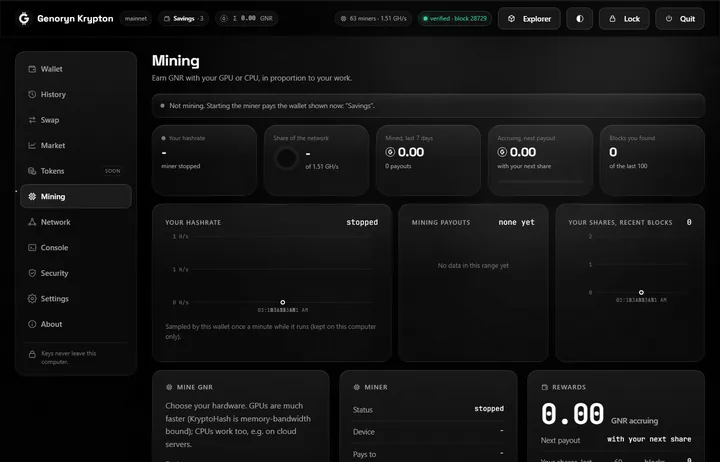
A GPU is roughly 40 to 50 times faster per device. CPUs still work, which is useful on cloud servers; the miner can cap CPU usage.
Do small miners earn anything?
Yes. Every block's reward is shared among all miners by the work they did: about 32 shares per block each earn an equal slice, so 1 % of the hashrate earns about 1 % of the rewards, without a pool.
Who controls the project?
Nobody. It was created by the pseudonymous Zarazi Sokani, whose identity will never be revealed. Anyone may build, market or extend it, but no one can change the rules without the nodes that run them.