 Genoryn Krypton
Quantum-resistant end to end
Spends are authorized by zk-STARK proofs over hashes, notes are encrypted with hybrid X25519 + ML-KEM-1024, peers talk over X25519 + ML-KEM-768. No elliptic-curve signature guards your coins.
Genoryn Krypton is private by default and secured only by hashes and NIST post-quantum cryptography. No premine, no owner, built for a hundred years.
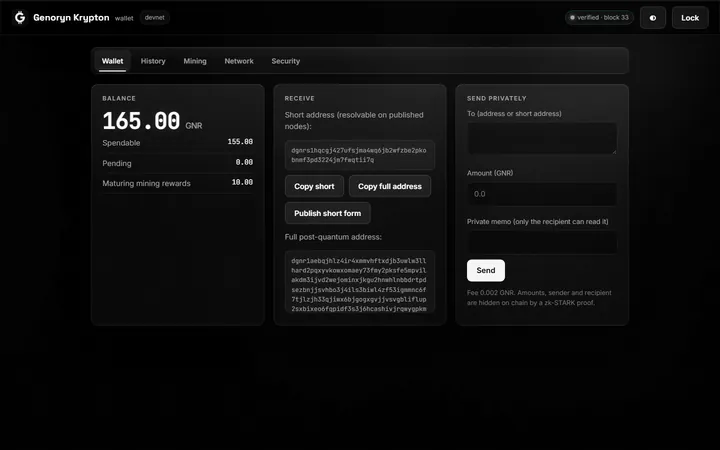
Spends are authorized by zk-STARK proofs over hashes, notes are encrypted with hybrid X25519 + ML-KEM-1024, peers talk over X25519 + ML-KEM-768. No elliptic-curve signature guards your coins.
Every transfer is shielded: sender, recipient and amount stay hidden. There is no transparent mode to fall back to, so privacy is the same for everyone.
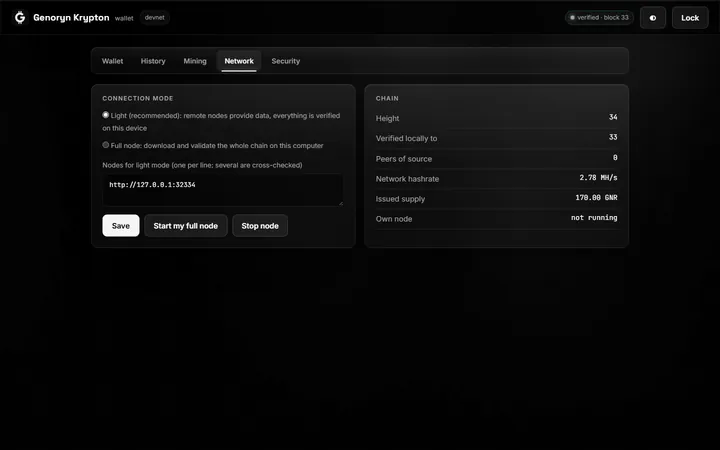
Light wallets check the chain with logarithmic MMR proofs and verify every block they read. Billions of blocks later it still takes seconds. Run a full node only if you want to.
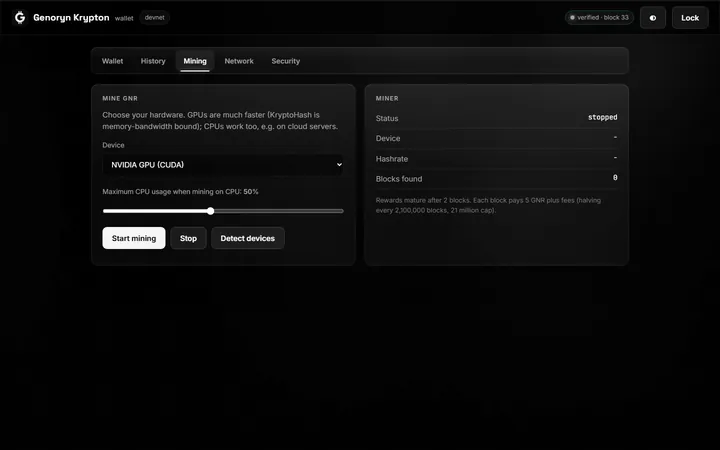
KryptoHash is memory-bandwidth bound: an RTX 5090 does about 74 MH/s, a 24-core CPU about 1.4 MH/s. Use CUDA, OpenCL or plain CPU threads, with a usage cap.
5 GNR per block, halving every 2,100,000 blocks, at most 21,000,000 GNR. The genesis issues nothing; there is no premine, no developer fund and no early bonus.
REST, JSON-RPC 2.0 and WebSocket APIs, a Rust SDK, C bindings and a TypeScript client. Exchanges and wallets get the same verified light protocol.
Create a wallet and write down 24 words. Keys never leave your device.
The wallet samples the chain, checks proofs of work and every block it reads.
Share your short address, or mine with your GPU or CPU from the wallet.
A zk-STARK proof is built on your device in under a second. Nobody sees who paid whom.
For everyday use on any computer.
Validate every rule yourself.
Secure the network, earn new coins.
"No key, no person and no company can mint, freeze or reverse."
Consensus rules, enforced by every node
"Security that rests on hashes outlives the curves of today."
Cryptographic design
"The author is unknown and will stay unknown. The code is the authority."
Zarazi Sokani, pseudonymous creator
Spends rely on zk-STARKs (hash functions only), note encryption uses ML-KEM-1024 (FIPS 203) combined with X25519, peers use ML-KEM-768. Shor's algorithm breaks none of these; Grover's algorithm only halves hash security, and 256-bit hashes keep a 128-bit margin. All algorithms are versioned so they can be upgraded by soft fork. The code has not had an independent audit yet.
No. The genesis block issues nothing and every block pays the same schedule: 5 GNR halving every 2,100,000 blocks. The mainnet genesis is bound to a Bitcoin block hash that did not exist before the launch announcement, so nobody could mine in advance.
No. The light wallet verifies the chain with MMR proofs (FlyClient-style sampling) and checks every block it reads against its header. You can switch to a full node at any time.
A GPU is roughly 40 to 50 times faster per device. CPUs still work, which is useful on cloud servers; the miner can cap CPU usage.
Nobody. It was created by the pseudonymous Zarazi Sokani, whose identity will never be revealed. Anyone may build, market or extend it, but no one can change the rules without the nodes that run them.
Download the wallet, join the testnet and mine your first block today.